Last reviewed: 17 June 2026
Reviewer: Sam Chugtai, Managing Director at Flow Office
Trying to pin down a single, fixed BREEAM price in the UK can be tricky. Usually, the overall cost of a BREEAM assessment is made up of three separate parts: the official charges from BRE or BREEAM itself, the fees paid to the assessor or consultant, and any project-specific costs related to gathering evidence, design support, coordination, or specialist studies. Because of this, two quotes might look quite different, even if they're for a similar type of building.
You might find that many older cost guides are out of date now. If you're currently working on a project budget, it's a good idea to check any cost discussions against the pricing context that followed the fee changes introduced from 1 May 2025. In this article, we'll walk you through what a BREEAM assessment actually involves, what your money is covering, why the prices can vary, and how to get the most accurate quote.
A BREEAM assessment cost is typically made up of three elements: BRE fees, assessor fees and project-specific costs. Total costs vary depending on the scheme, building size, complexity, target rating and stage of appointment. Projects targeting higher ratings or requiring additional specialist studies will generally incur higher costs.
Summary
- What is a BREEAM assessment?
- How much does a BREEAM assessment cost in the UK?
- What affects BREEAM cost?
- BRE fees vs assessor fees
- 2025 fee changes clients should know about
- Hidden costs that can push a BREEAM budget higher
- Cost differences by BREEAM scheme
- Why timing matters: design stage vs post-construction
- Is BREEAM worth the cost?
- How to get an accurate BREEAM quote
What is a BREEAM assessment?
BREEAM stands for Building Research Establishment Environmental Assessment Method.
It is a framework for sustainability assessment and certification, used across new developments, refurbished buildings, existing assets, communities and infrastructure. In simple terms, it helps project teams measure how well an asset performs against recognised sustainability criteria.
A BREEAM assessment looks at topics such as:
- Management
- Energy, water and waste
- Transport
- Health and wellbeing
- Materials
- Land use and ecology
- Pollution
- Innovation
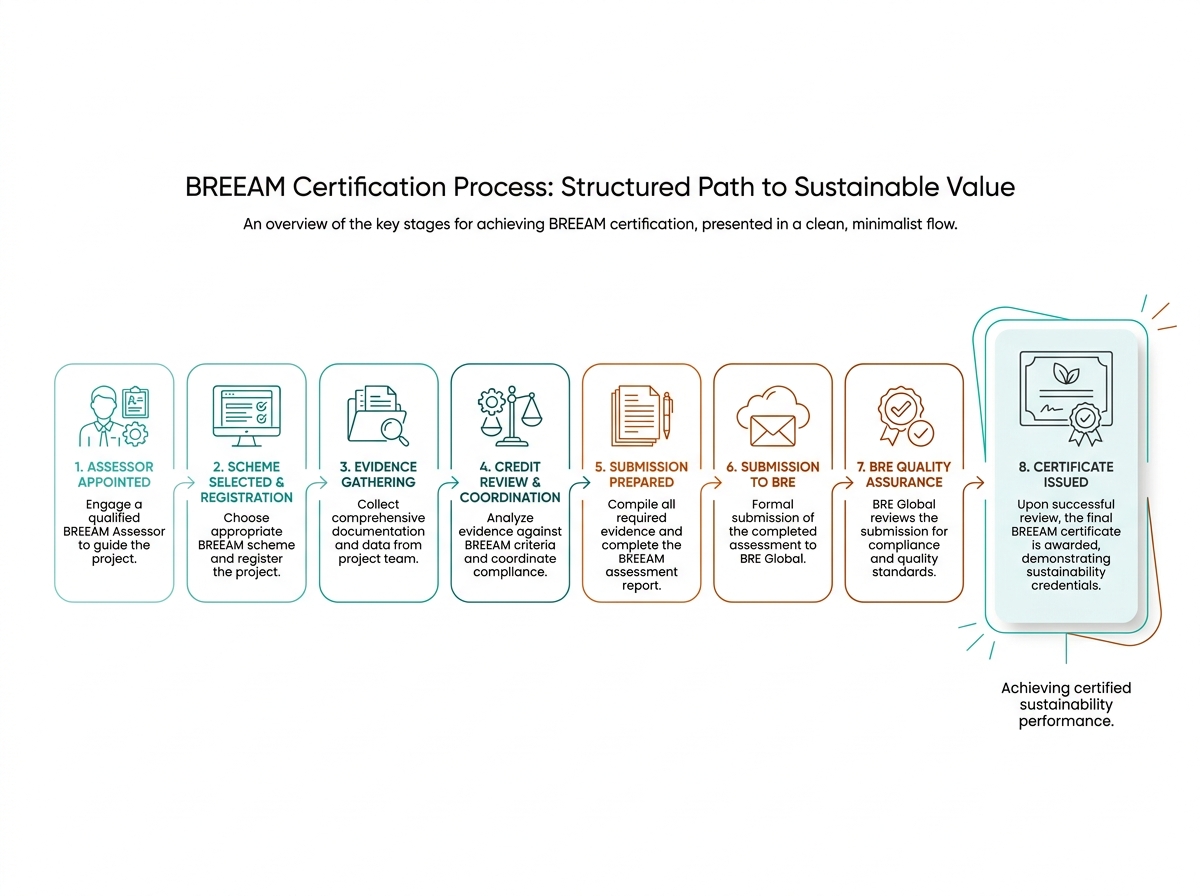
It's helpful to remember that the process and the final certificate are actually two different things. The assessment is the active work that happens throughout your project: picking the right scheme, gathering and reviewing evidence, tracking credits, and putting together the final submissions.
The certificate, on the other hand, is the official result you get once all the rigorous quality assurance checks are done and a rating has been formally awarded.
You'll have a licensed BREEAM assessor or auditor guiding you through that entire process, with BRE then carrying out those essential quality assurance steps before the certification is issued.

What Might a Typical BREEAM Budget Include?
While every project differs, clients should generally budget for:
- Official BRE registration and certification fees
- BREEAM assessor consultancy fees
- Any additional studies, modelling or evidence requirements
The balance between these costs varies considerably depending on project type and certification target. A simple existing asset review under an operational scheme will not be priced in the same way as a major new-build development targeting Excellent or Outstanding ratings.
| Cost bucket | What it covers | Why it varies |
|---|---|---|
| BRE or BREEAM fees | Registration, certification, quality assurance and scheme-related charges | Depends on scheme, asset type, size band, stage and any extra services |
| Assessor or consultant fees | Professional time for advising the team, reviewing evidence, coordinating submissions and managing the assessment | Depends on project complexity, target rating, timing and scope of support |
| Project-specific extras | Specialist studies, design changes, extra evidence gathering, resubmissions and administration | Depends on how prepared the team is and what the project needs to achieve |
This split is important. BRE fees are official scheme charges and only form one part of the total budget. Assessor fees sit alongside them, and are not included, unless a quote clearly states otherwise. On top of that, projects often incur indirect costs when extra studies, redesign work or further evidence are needed to secure the target rating.
What affects BREEAM cost?
Project size and complexity
Larger projects often involve more credits, more documents, more stakeholders and more coordination. Mixed-use or unusual developments can also take longer to assess because evidence is less standardised and scope decisions may need more care.
Building type
A straightforward office building can be easier to assess than a specialist asset with unusual servicing, occupancy patterns or regulatory constraints. Complex technical systems, phased delivery and operational interfaces can all increase workload.
BREEAM scheme selected
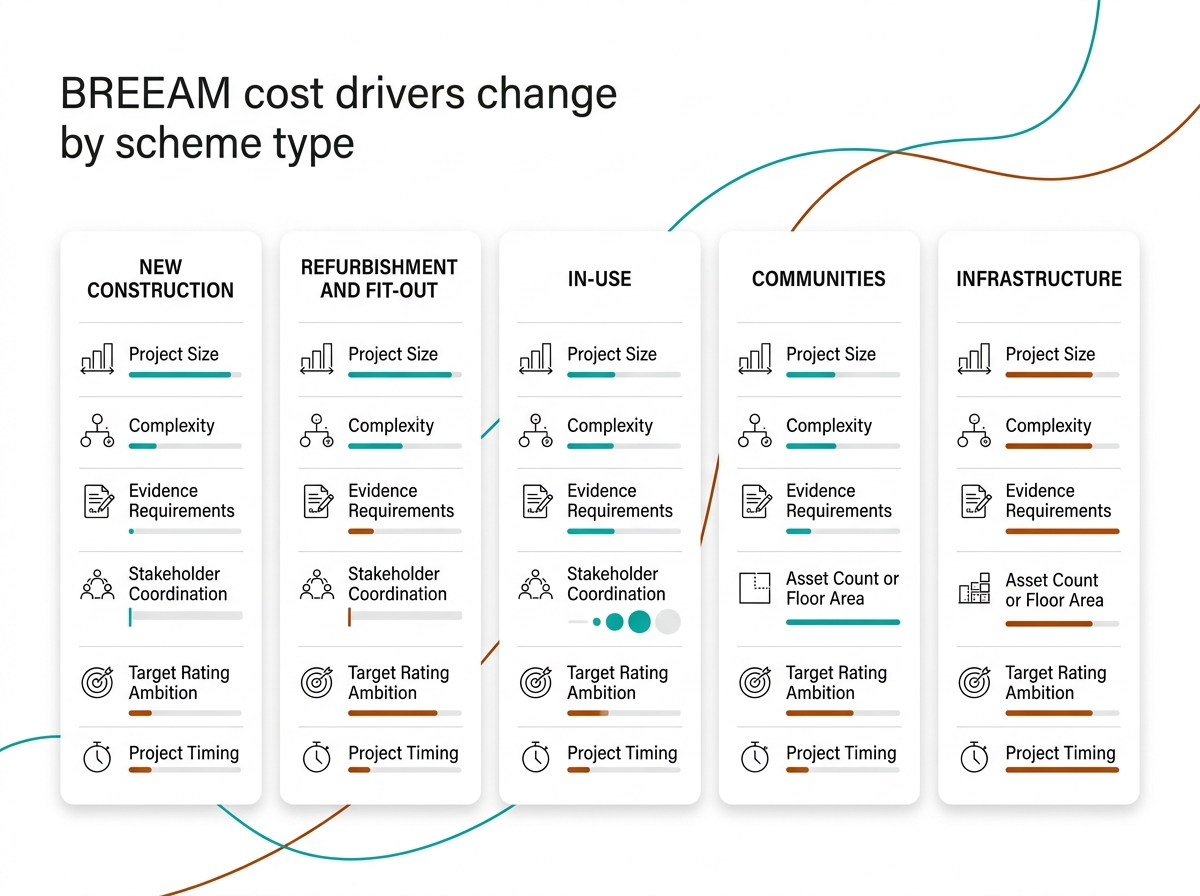
Schemes include New Construction, Refurbishment and Fit-Out, In-Use, Communities and Infrastructure. Each of these has its own process and pricing logic. Some are based more around floor area, some around asset count, some around construction value, and some involve different quality assurance routes.
Target rating
A project aiming for Pass or Very Good may need less iteration than one targeting Excellent or Outstanding. Higher ratings often demand earlier decisions, tighter evidence management and, in some cases, more specialist input.
Timing of appointment
Early appointment usually reduces friction. When the assessor joins at concept or early design stage, the team can plan credits and evidence properly. When appointment happens late, more time is often spent chasing information, testing whether opportunities have already been missed, or managing gaps in the record.
Quality of available evidence
Well-organised projects with clear drawings, specifications, reports and responsibilities are usually more efficient to assess. Where information is incomplete or arrives late, consultant time increases and QA risks often rise with it.
BRE Fees vs Assessor Fees
This is where many budget conversations become confusing BRE or BREEAM fees are the official charges attached to the scheme itself. Depending on the route, they can include registration, certification, quality assurance, renewals, amendments or other scheme services. These charges are set by the scheme and may be invoiced under the relevant BREEAM rules for that project or asset type.
Assessor fees are different. They cover the professional work carried out by the licensed assessor or sustainability consultant, which usually includes:
- setting up the assessment strategy
- advising the design team
- reviewing evidence, identifying risks
- preparing submissions
- handling communication during the certification process
So when you receive a low quote, ask what is included. Does it include official BRE fees? Does it cover both design-stage and post-construction work? Does it include meetings, evidence reviews, re-submissions or specialist coordination? Comparing quotes line by line to avoid surprise costs later on.
2025 Fee Changes to Consider
It’s worth being aware that BRE fees for certain schemes increased on 1 May 2025, and projects registered on or after this date may fall under revised pricing. This means that project budgets prepared before May 2025 may no longer accurately reflect current certification costs. Clients reviewing older feasibility studies should ensure that cost assumptions have been updated.
On average, the increase was roughly 7.5% for New Construction and Refurbishment schemes, and around 5% for Communities, In-Use and certain other service fees. You should still check the current scheme documentation or ask for an up-to-date assessor proposal to avoid errors here.
Hidden Costs that can Push a BREEAM Budget Higher
Costs can shift if your project changes down the line. Late design changes are a likely cause of increases, because if you tweak specifications after your BREEAM credits have been planned, your assessor will need to go back, review the impact, maybe rework the strategy, and gather new evidence.
Common examples include:
- Additional energy modelling
- Ecology surveys
- Acoustic assessments
- Daylight studies
- Transport assessments
- Late design revisions
- Missing product compliance information
Another frequent snag is incomplete evidence. Things like missing product data, unassigned responsibilities, vague drawings, or absent commissioning info can lead to extra rounds of checking. The same applies if BRE's quality assurance team flags queries that require you to resubmit or provide clarifications.
For longer projects, watch out for late completions. Delays can mean more time for the consultant, push work into different reporting periods, or even bump into new fee structures. Extra specialist studies, re-scoping, admin changes, certificate amendments, and further modelling can all add to the original budget.
The best approach is not to expect a perfectly fixed price from day one. Instead, make sure you really understand the assumptions your quote is based on and know where a change-control process will apply. This will help you prepare for any necessary adjustments.
Cost Differences by BREEAM Scheme
New Construction
Used for newly designed and constructed assets and new-build extensions. Costs often reflect the need to coordinate sustainability requirements through design and construction stages. Rating ambition, asset size and the structure of stage submissions can all influence the amount of assessor input required.
Refurbishment & Fit-Out
Used for retrofit, refurbishment and fit-out work. Pricing can differ because scope boundaries need to be defined carefully, especially where shell, core systems, local services and interiors are not all being touched in the same way. Existing-building constraints can also make evidence and credit planning more involved.
In-Use
Used for existing operational assets. This route can look more modular because it may involve asset measurement, verification, certification and renewals on a per-asset basis. For some portfolios, scale can help, but asset complexity and the quality of management information still shape workload.
Communities
Used for large-scale development plans and regeneration master plans. The process is different from a single-building assessment, so quotes are typically shaped by the scale of the site, stakeholder engagement, phasing and the breadth of evidence needed at master planning stage.
Infrastructure
Relevant where the project falls within the infrastructure route. Here, official charges can depend on project construction value, assessment type and verification arrangements, which is another reason not to assume that all BREEAM costs work in the same way.
Why Timing Matters: Design Stage vs Post-Construction
Timing affects both efficiency and cost. When you appoint a BREEAM assessor early, the team has a better chance of selecting realistic credits, building evidence requirements into the programme and avoiding last-minute surprises. That usually means smoother coordination and less rework.
A later appointment often creates more pressure. Credits may already have been lost, design decisions may be harder to change and evidence may need to be reconstructed after the event. That tends to increase consultant time and can also affect the confidence of the final target rating.
Early appointment reduces avoidable friction, so look for a BREEAM consultancy to join the project during the design stage.
Is BREEAM Worth The Cost?
That depends on the project and its objectives, but the value case is real. BREEAM positions certification around asset value, resilience, ESG alignment, disclosure support and independent third-party assurance. For many organisations, the value extends beyond certification itself. BREEAM can support planning requirements, strengthen ESG reporting, improve investor confidence, enhance occupier appeal and demonstrate independent sustainability performance.
The answer is strongest where sustainability performance needs to be demonstrated in a credible, structured and comparable way. For other projects, the benefit may be more strategic than immediate, such as future-proofing an asset, improving marketability or aligning a portfolio with broader environmental goals.
It is still important to stay balanced. BREEAM is not automatically the right route for every project, and the right level of ambition depends on budget, procurement constraints and the reason certification is being pursued in the first place.
Your BREEAM Cost Estimate
Every project is different, which is why accurate pricing depends on understanding the scheme, rating target, building type and project stage.
Our consultants can provide an initial review of your project requirements and explain the likely costs associated with BRE fees, assessment services and any additional evidence requirements.
Contact Flow Office to discuss our project-wide consultancy service for BREEAM and SKA assessments.
FAQs
How much does a UK BREEAM assessment cost?
There is no single national price. The total usually includes official BRE or BREEAM fees, assessor fees and project-specific costs such as evidence gathering or specialist studies.
Are BRE fees included in a BREEAM quote?
Sometimes, but not always. Some proposals include official scheme charges and some list them separately. Always check the scope.
What affects BREEAM cost the most?
Scheme type, project complexity, target rating, timing of appointment and the quality of available evidence usually have the biggest impact.
When should I appoint a BREEAM assessor?
Ideally at concept or early design stage. Early appointment usually reduces rework and helps the team plan credits and evidence properly.
Can I reduce BREEAM assessment costs?
Often, yes. Clear scope definition, early appointment, organised evidence and realistic rating targets can all reduce avoidable consultant time and project friction.
Is BREEAM mandatory in the UK?
Not universally. Some projects pursue it because of planning policy, employer requirements, investor expectations or market positioning, while others choose it voluntarily.