Last reviewed: 17 June 2026
Reviewer: Sam Chugtai, Managing Director at Flow Office
The Short Answer:
BREEAM is the BRE’s Environmental Assessment Method. It is a framework used to assess and certify the sustainability performance of buildings, fit-outs, refurbishments and wider development projects.
For anyone involved in a major construction project, BREEAM is the method that turns sustainability aims into a structured, evidence-based process rather than a loose set of aspirations.
In practice, BREEAM is important because it affects design decisions, specification choices, planning conversations, ESG reporting and, in some cases, leasing and investment expectations.
The official BREEAM standards overview positions certification as a way to support performance, value and ESG goals. Our BREEAM consultancy service focuses on building those considerations into space planning, specification and evidence collection early enough to avoid last-minute gaps.
Why are so many developers, landlords and occupiers prioritising BREEAM?
As sustainability, ESG reporting and planning requirements become increasingly important, BREEAM has become one of the UK's most recognised frameworks for measuring and improving building performance. Whether you're planning a new development, refurbishment or office fit-out, understanding BREEAM can help you make better design decisions, reduce risk and improve long-term asset value.
This guide explains how BREEAM works, how ratings are achieved, when certification may be required and why involving a BREEAM consultant early can save both time and cost.
What does BREEAM stand for?
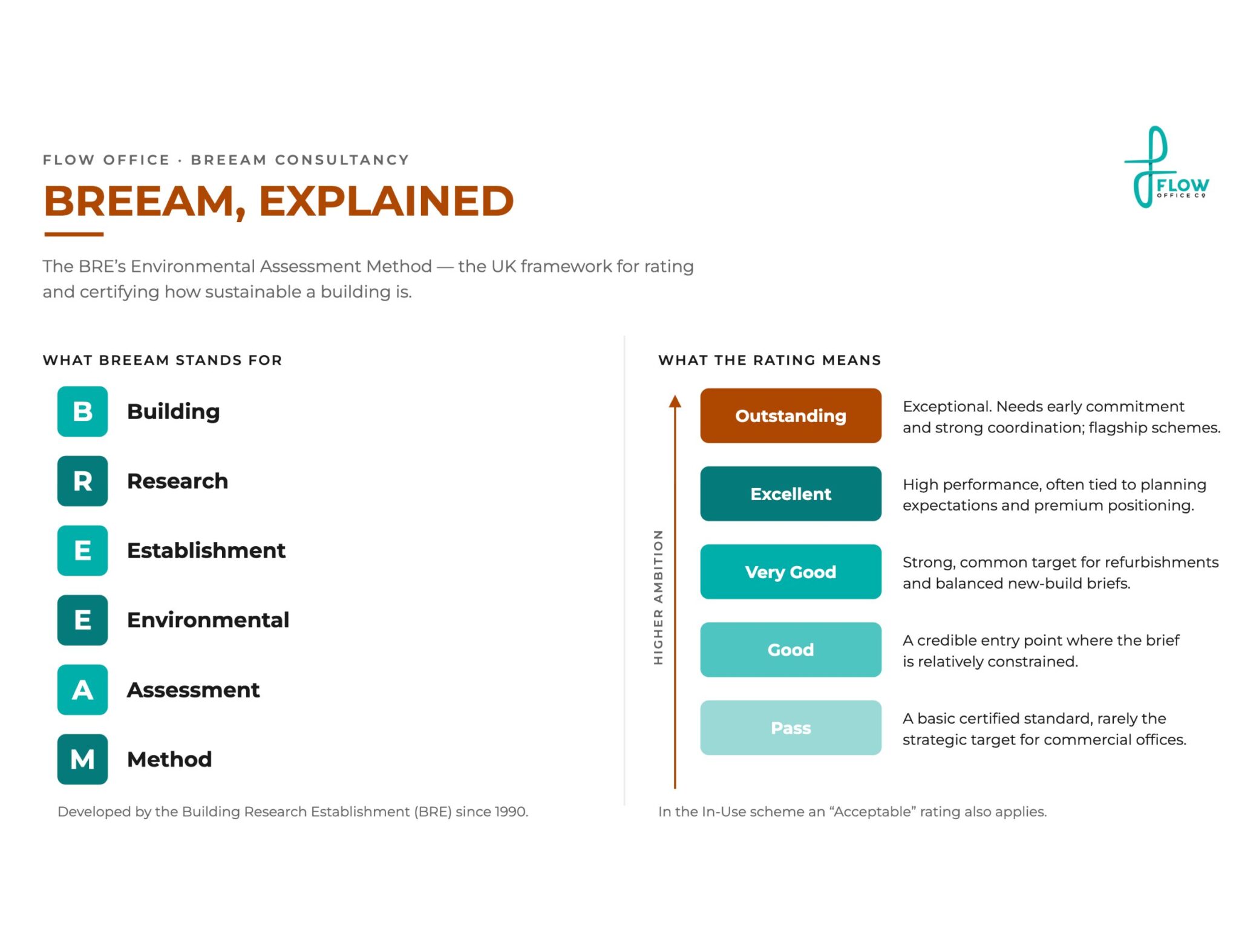
BREEAM stands for Building Research Establishment Environmental Assessment Method, developed and administered by the Building Research Establishment (BRE) since 1990.
The method now functions more broadly as a family of sustainability standards, both NBS and Designing Buildings describe BREEAM as a long-established sustainability assessment method used across the built environment.
How BREEAM is Applied in Construction, Development and Renovation
In buildings, infrastructure and wider development work, BREEAM provides a framework that supports various functions:
- Setting performance targets
- Guiding design and procurement decisions
- Assessing delivery against defined criteria
- Providing third-party certification at key stages
That breadth is a key reason why it remains commercially relevant in the UK market.
Best practice is to use BREEAM holistically, throughout the project development process, to make sure sustainability is embedded in the design rather than added on as a surface layer.
How BREEAM Works
BREEAM assesses sustainability by awarding credits across a defined set of categories:
- Energy
- Land use and ecology
- Water
- Health and wellbeing
- Pollution
- Transport
- Materials
- Waste
- Management
Categories are weighted and their combined performance is translated into an overall rating. This prevents a project from claiming strong sustainability performance on one issue while ignoring others that affect long-term value, operational quality or user experience. The structure is deliberately broader than energy compliance alone, preventing cheap ‘greenwashing’ activity that can mask unscrupulous practices in other areas.
Types of Projects using BREEAM in the UK
In the UK, BREEAM is used across new construction, refurbishment and fit-out, and existing operational assets. The BREEAM standards page and Refurbishment and Fit Out standard make clear that the framework is not only for ground-up development.
Landlords and occupiers use BREEAM as much as developers and architects, as many office projects are repositioning, upgrading or refitting existing space, rather than starting from a blank site. If the brief includes sustainability targets, a landlord wants stronger ESG evidence, or a fit-out needs to align with a wider asset strategy, it’s worth involving a BREEAM consultancy.
Supporting Sustainable Design and Lower Environmental Impact from the Start
At design stage, BREEAM gives teams a structured way to think about energy, water, materials, waste, pollution, transport, health and wellbeing, resilience and ecology before those issues become expensive to change.
The BRE encourages teams to use the framework from as early in the project as possible: it is more useful as a design management tool than as a box-ticking exercise at the end. The final grading you can achieve will be impacted by decisions about layout, services, finishes, travel facilities, daylight, acoustics, materials and commissioning.
Improving Asset Value, Efficiency And Occupier Wellbeing
The commercial case for BREEAM is broader than carbon language. The BREEAM In-Use standard explicitly links certification to routes such as supporting ESG reporting, reducing operational costs, driving sales and rental values, and providing independent third-party assurance. BREEAM’s own material also connects the framework with health, wellbeing, resilience and financial value, which is why developers and landlords often use it to strengthen both asset positioning and occupier confidence.
Helping Meet Client, Planning and ESG Expectations
BREEAM is also important because it often sits inside wider requirements rather than standing alone. Some planning authorities expect ambitious BREEAM targets, and many client briefs use it as a shorthand for credible sustainability ambition. The City of London’s sustainable development planning requirements, for example, say major schemes should aim for BREEAM Excellent or Outstanding. For teams handling planning risk, investor scrutiny or occupier ESG questions, that makes BREEAM a practical delivery issue as much as a sustainability one.
What does BREEAM measure?
BREEAM measures performance across multiple categories rather than relying on a single environmental metric. Current BREEAM material refers to categories spanning management, health and wellbeing, energy, transport, water, materials, waste, land use and ecology, pollution, resources, resilience and innovation, depending on scheme and version. The point for project teams is simple: the framework looks at how a building is designed, delivered and, in some standards, operated over time.
Energy, water, materials and waste
These are often the most visible parts of a BREEAM conversation because they connect directly to efficiency, embodied impact, operating cost and resource use. In office projects, that can mean lower water consumption, better-performing services, more responsible material specification and stronger waste planning. These are also the areas where early coordination between designers, contractors and suppliers makes the biggest difference to both performance and evidence collection.
Health and wellbeing, transport and pollution
BREEAM also measures how a building supports the people using it and the context around it. BREEAM’s own health and social impact material highlights factors such as ventilation, thermal comfort, visual comfort and air quality, while the broader category set includes transport and pollution. For occupiers, this is where BREEAM moves beyond technical compliance and starts to affect the day-to-day experience of a workplace.
Ecology, management, resilience and innovation
The management and resilience categories matter because sustainable performance is not only about the finished specification. It is also about briefing, coordination, risk management, long-term adaptability and how the asset will respond to future pressures. BREEAM’s current material places clear emphasis on resilience, circularity and long-term performance, which is one reason the framework remains commercially relevant for future-facing portfolios.
How does a BREEAM assessment work?
A BREEAM assessment is a structured process rather than a single review at the end of a project. Registration happens through a licensed assessor, the project is assessed against the relevant standard, evidence is gathered and reviewed, and certification is issued at the appropriate stage. The BREEAM certification process describes early registration as a way to embed sustainability into design and procurement decisions from the outset.
The role of a licensed BREEAM assessor
A licensed BREEAM assessor is central to the process. BREEAM training material explains that assessors undertake assessments, award ratings within the scheme process and submit projects for certification. In practical terms, that means the assessor helps interpret requirements, reviews evidence and provides the formal route into certification. For client teams, it is useful to think of the assessor as part technical guide, part process controller and part compliance check.
Design stage and post-construction certification
BREEAM commonly uses more than one assessment stage. The design stage captures the expected performance of the scheme before it is built, while post-construction certification checks what was actually delivered. That split is important for trust. It means a project cannot rely only on design intent if procurement, substitutions or delivery decisions change the result later.
How BREEAM scores and ratings are calculated
BREEAM awards credits against criteria in different categories, applies weightings, then converts the overall score into a rating. The official rating scale used in core BREEAM conversations is Pass, Good, Very Good, Excellent and Outstanding. That method is one reason BREEAM is often seen as more credible than informal sustainability claims. The result comes from a defined assessment process with evidence and quality assurance behind it.
BREEAM rating levels
The rating itself is often the part clients remember, because it becomes the shorthand used in planning submissions, board papers and leasing conversations. What matters commercially is not only the label but whether the project target is realistic for the programme, budget, building type and stage of design.
| Rating | What it tends to mean in practice |
|---|---|
| Pass | A basic certified standard, rarely the strategic target for ambitious commercial office projects |
| Good | A credible entry point where certification matters but the brief is relatively constrained |
| Very Good | A strong and common target for many commercial refurbishments and balanced new-build briefs |
| Excellent | A high-performing target often associated with planning expectations, investor scrutiny and premium positioning |
| Outstanding | A very demanding target that usually needs early commitment, strong coordination and limited compromise later |
What rating should a project aim for?
For many office and refurbishment schemes, Very Good is a practical target when the aim is to demonstrate genuine performance without overstretching budget or programme. Excellent is often the right ambition where planning expectations, portfolio standards or high-value occupier requirements are in play. Outstanding can be right for flagship schemes, but it should be chosen with open eyes because it usually requires strong early-stage control over design and evidence. The City of London guidance is a useful example of a market context where Excellent or Outstanding may be the assumed benchmark.
How Much Does BREEAM Certification Cost?
The cost of achieving BREEAM certification varies depending on the size, complexity and scope of the project.
Typical costs may include:
- Registration fees
- Assessor fees
- Consultancy support
- Design and specification changes
- Evidence gathering and administration
The earlier BREEAM is considered, the easier it is to integrate requirements into the project and avoid costly redesigns later.
When is BREEAM required?
BREEAM is not universally mandatory across all UK projects. In practice, it becomes required through a mix of planning policy, public-sector requirements, funding conditions, investor expectations or client brief instructions. That distinction matters, because teams often ask whether BREEAM is “required” when the more accurate question is whether the scheme can realistically proceed or compete without it.
Planning requirements and local authority expectations
Some local authorities explicitly set BREEAM expectations for relevant schemes. The City of London says major developments and refurbishments should aim for BREEAM Excellent or Outstanding, which shows how certification can become part of a planning strategy rather than an optional extra. Teams should therefore review local planning guidance at the very start, not after concept design has settled.
Public-sector and client-led requirements
Outside planning, BREEAM is often required by client standards, ESG commitments or procurement frameworks. Landlords may use it to support asset positioning and reporting, while occupiers may require it as part of wider sustainability or workplace commitments. The point is that the obligation may come from the commercial brief rather than from legislation.
Check requirements early
A late discovery that BREEAM is expected can create avoidable cost and friction. The earlier the team understands the target rating, evidence burden and design implications, the easier it is to protect the most valuable credits and avoid redesign. That is why early brief review is usually more important than late-stage firefighting.
Why early BREEAM advice matters
Early BREEAM advice matters because some of the most influential decisions are also the hardest to change once the design is moving. BRE’s own knowledge base is clear that the purpose of early AP involvement is to steer performance from the outset at the least cost and risk, and that late consideration can increase costs. The same principle appears in older NBS guidance, which notes that early assessment makes higher ratings easier and more cost-effective to achieve.
Design decisions that affect BREEAM performance early on
Targets for transport, health and wellbeing, energy, materials, space planning, services coordination and specification choices are often shaped early. In office projects, that can include cycle facilities, showers, daylight strategy, acoustic performance, metering, finishes, responsible sourcing and commissioning plans. Once those fundamentals are fixed, recovering missed opportunities becomes harder.
How late-stage changes can increase cost and complexity
Late-stage BREEAM work tends to be expensive for a simple reason: the easiest credits are usually the ones designed in from the start. If evidence has not been planned, if suppliers were never briefed, or if the layout and specification work against the target rating, the team ends up chasing alternatives under pressure. That increases coordination time, change risk and the chance of settling for a lower rating than originally intended.
When to involve a BREEAM consultant
The sensible point to involve a consultant is when the brief, budget and sustainability ambition are still being shaped. Flow Office’s BREEAM consultancy offer centres on confirming the target rating, mapping risks early, and building BREEAM considerations into space planning and specification so the layout and finishes support the credit strategy rather than work against it. For fit-out teams, that early coordination is often the difference between a manageable process and a reactive one.
How Flow Office Can Help You Achieve Your BREEAM Goals
Flow Office is well placed where BREEAM overlaps with office design, fit-out and workplace performance. Rather than treating certification as a separate compliance stream, the business frames it as part of the wider design and delivery process. That matters because many BREEAM outcomes are shaped by space planning, product selection, coordination and project timing as much as by formal paperwork.
Advice at planning and design stage
At early stage, Flow Office can help define the target outcome, identify the design decisions that will influence performance, and coordinate sustainability thinking alongside layout and fit-out development. That is especially useful where the commercial objective is not only to secure a certificate, but to create a workplace that also performs better for occupiers. Relevant support can sit alongside wider office design and office fit-out work.
Support with evidence, coordination and compliance
One of the most time-consuming parts of BREEAM is not the concept. It is the evidence trail. Flow Office’s BREEAM page emphasises coordination of actions and evidence across the wider project team, which is exactly where many schemes lose momentum if responsibilities are unclear.
Helping teams target the right BREEAM outcome
The right target is the one that fits the project’s commercial reality. Flow Office’s approach is useful here because it starts with programme, budget and constraints rather than assuming every project should chase the highest headline rating. That makes the advice more credible and more useful to decision-makers who have to balance sustainability ambition with delivery risk.
Ready to discuss your project?
Whether you're at planning stage, developing a fit-out strategy or reviewing sustainability requirements, our team can help identify the most effective route to achieving your BREEAM objectives.
Contact Flow Office today to discuss your project.
Frequently asked questions about BREEAM
Is BREEAM mandatory?
Not across the board. BREEAM becomes necessary when planning guidance, a public-sector framework, investor expectations or a client brief makes it part of the project requirements. Some authorities, such as the City of London, are explicit about the rating level they expect relevant schemes to aim for.
Is BREEAM only for new buildings?
No. BREEAM also covers refurbishment, fit-out and existing operational assets through standards such as Refurbishment and Fit Out and In-Use.
What is a good BREEAM rating?
That depends on the project. For many commercial schemes, Very Good is a strong baseline and Excellent is the target that starts to align with tougher planning or investor expectations. A good rating is one the team can achieve credibly without undermining delivery.
What is the difference between BREEAM and LEED?
BREEAM is BRE’s assessment and certification framework, widely used in the UK and across multiple lifecycle stages. LEED, by contrast, is the U.S. Green Building Council’s rating system for healthy, efficient and cost-saving buildings and applies across design, construction, operations and maintenance. Both are recognised frameworks. The better fit depends on geography, stakeholder expectations and the project brief.
When should I appoint a BREEAM consultant?
Ideally before major design and specification decisions are fixed. BRE’s guidance is explicit that early involvement helps maximise performance for the least cost and risk, while late consideration tends to increase cost and complexity.